Welcome back to our second newsletter! February was a huge month for Lumios - we shipped an entirely new Discovery & Review module, upgraded the AI case assistant, added new collection integrations, and hit some exciting business milestones. Here's the full rundown.
Company Updates
- We just closed a funding round backed by some top funds, top GCs and CLOs. We're incredibly grateful for the support and excited to put this capital to work and grow the business much faster with our new partners! We'll share more on this soon in an official announcement.
- We're now running sandboxes with customers on mock case data - giving teams a chance to imagine what using the product on a real case looks like while they start on security review.
- We're working with some great boutique law firms already and running pilots with several larger firms. If you're interested in getting access, reach out - we'd love to talk.
- We're also actively working with in-house legal teams - helping them manage discovery obligations, respond to subpoenas, and handle document-heavy workflows without the overhead of traditional review platforms. If you're in-house and want to see how Lumios fits into your process, we'd love to show you.
Discovery & Review NEW
This is the big one. Most eDiscovery platforms treat AI as a bolt-on - a search feature here, a classification model there, layered on top of workflows that were designed decades ago. We built our Discovery & Review module from scratch with AI at the core. The AI doesn't just assist the review process - it drives it, learns from your corrections in real time, and handles the grunt work so your team can focus on judgment calls.
Before a single reviewer touches a document, the AI has already analyzed the full set and generated suggestions on responsiveness, privilege, confidentiality, and more. That means your seed set isn't starting from zero - the AI comes in with an informed view of every document, so reviewers are confirming and refining rather than starting cold. As your team reviews and corrects, the model updates its predictions across the remaining documents in real time.
The review interface centers around a configurable coding panel - you define your own fields (responsiveness, privilege, confidentiality, or anything else), and every field is mapped to keyboard shortcuts so reviewers can code documents without lifting their hands off the keyboard.
For discovery responses, the AI generates draft objections and responses for each request. The real power is the learning loop: edit one objection, and the AI automatically propagates your improvements to similar items across the entire set. Instead of rewriting the same boilerplate 50 times, you refine once and the system learns your style. This is fundamentally different from tools that just generate a first draft and leave you to manually fix the rest - Lumios keeps learning as you work.
When it's time to produce, the visual redaction tool lets you draw redactions directly on documents with on-page markup. Once redactions are applied, the production runner handles Bates stamping, generates load files, and packages everything into a ZIP export - ready to deliver.
Defensibility is built into every step. The QC dashboard runs automated validation checks across your production set - flagging inconsistencies, missing codes, and potential privilege breaks before anything goes out the door. Every AI decision is logged with a full reasoning trail, including the prompts used, the model's confidence scores, and reviewer overrides, so you have a complete audit trail if your process is ever challenged. Combined with recall sampling tools and statistical validation, your team can demonstrate the rigor of the review to any court. Saved searches with a boolean query builder let your team bookmark complex queries and reuse them across review sessions.
We also shipped an ECA (Early Case Assessment) dashboard with custodian-level analysis and key term hit reports - giving you a bird's-eye view of your data before you dive into full review.
AI Case Assistant
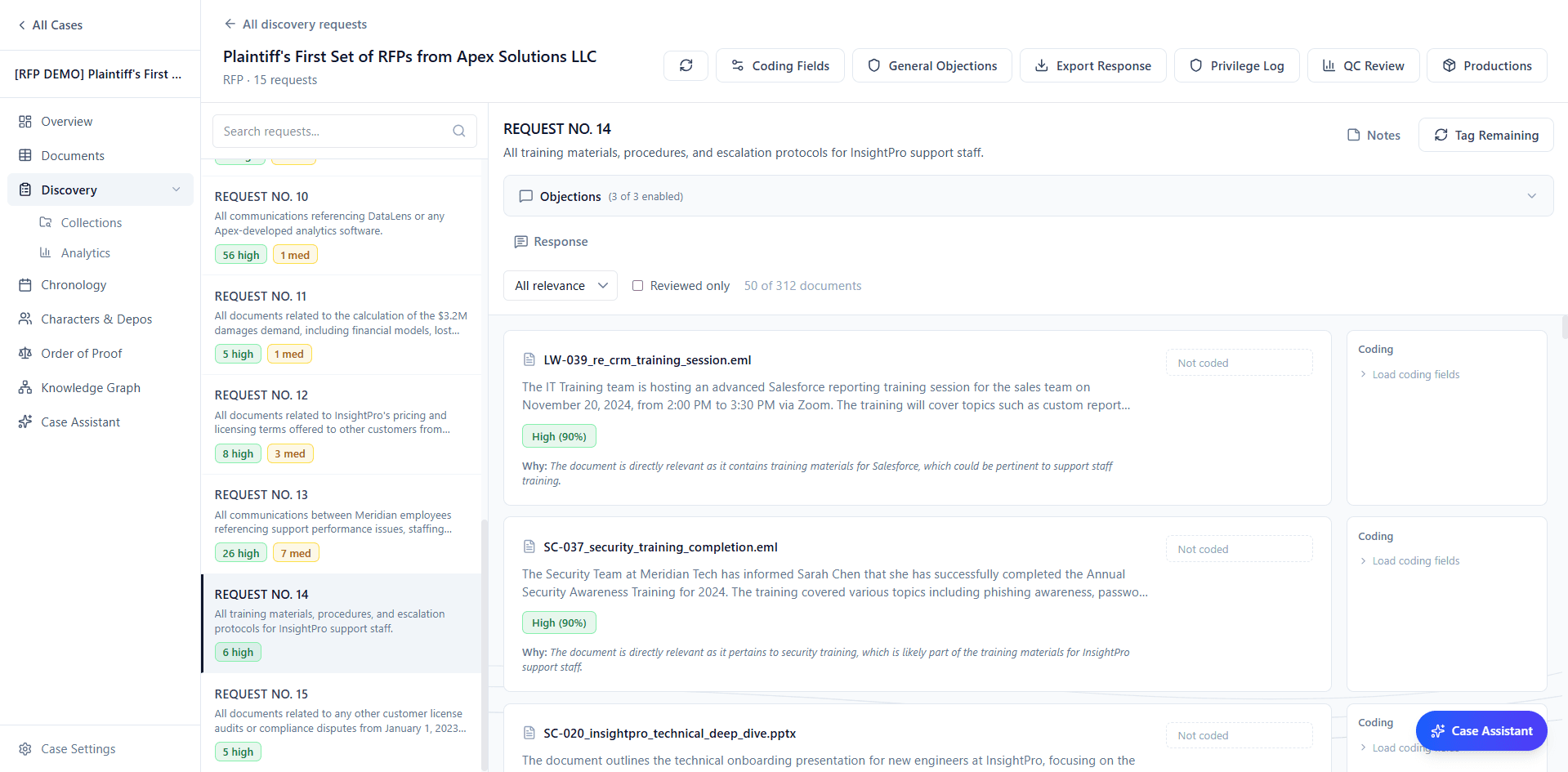
The case assistant is an AI that understands your entire case - across millions of documents - and can actually do work, not just answer questions. It's forced to cite every claim it makes with direct references to source documents, so nothing is taken on faith. Ask it a question and it pulls the relevant exhibits, surfaces the key passages, and links you straight to the source.
But it goes beyond search. The assistant can build real work product - it generates artifacts like tables, timelines, and draft documents that you can save, edit, and export. It can also interact directly with the app itself: add facts to your chronology, attach exhibits to your order of proof, update character profiles, and more. It maintains multi-turn memory across extended conversations, so you can have a real back-and-forth without losing context.
To keep things trustworthy at scale, we built a hallucination detection pipeline that flags responses where the AI's confidence is low or the answer doesn't align with the source material. The result is an assistant that works off of millions of documents without hallucinating - and when something needs a second look, it tells you. The chat history and artifacts panel has also been redesigned for faster navigation.
Collections
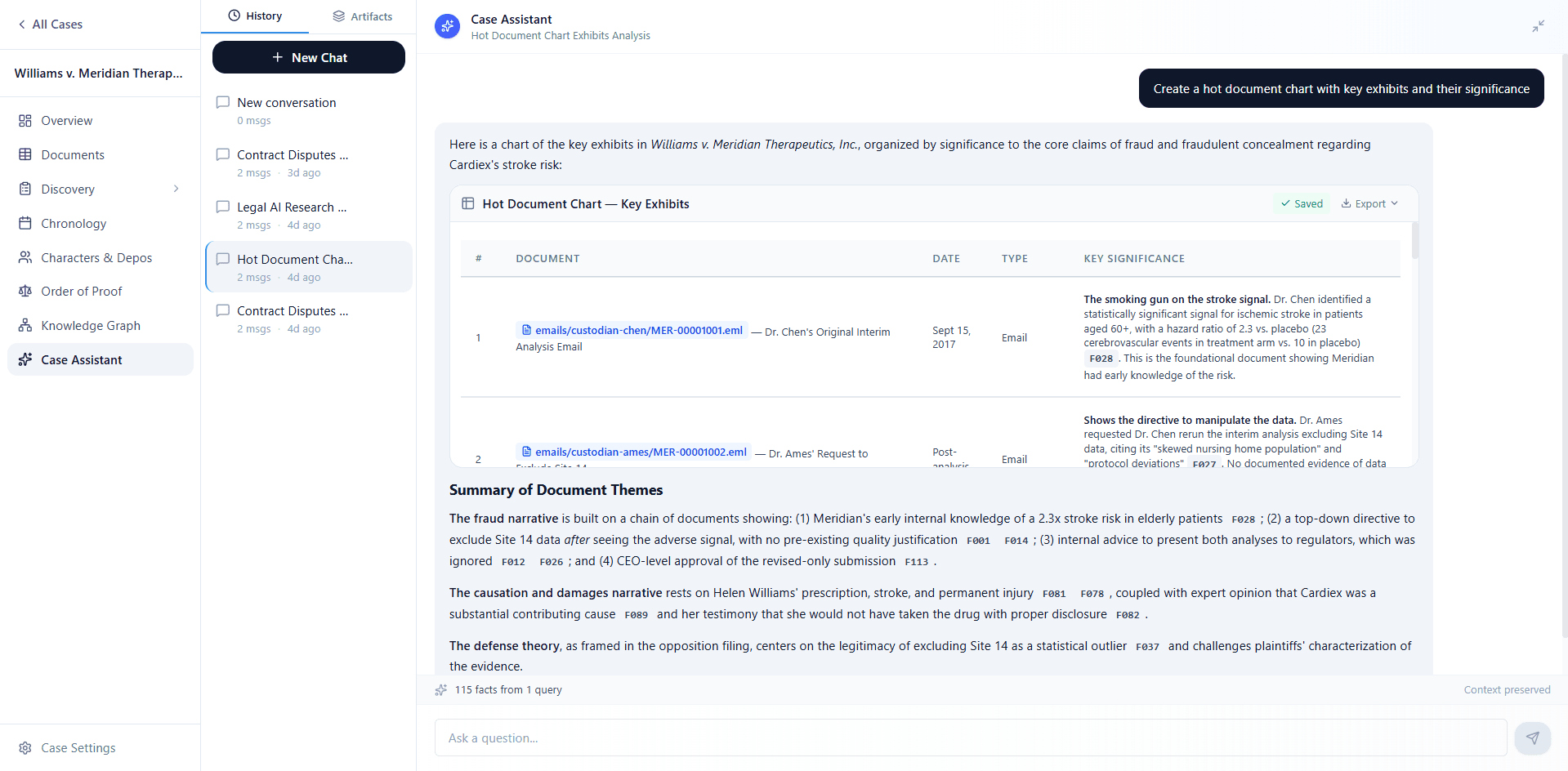
Lumios now connects directly to Slack, Google Drive, Box, ShareFile, and Microsoft Teams for native data collection - with more integrations rapidly being built out. Once a source is connected, the system is intelligent enough to understand your case context and automatically identify what's relevant to pull in - the right custodians, the right date ranges, the right channels and folders. You review and approve, but the heavy lifting of scoping the collection is handled for you.
Everything runs through a unified collection profile workflow - set up a run, preview what will be pulled in, approve it, and the data flows into your case automatically with metadata, threading, and folder structure preserved. No more juggling export tools and manual uploads. If your team uses a source we don't support yet, let us know - we're happy to prioritize.
Document Processing
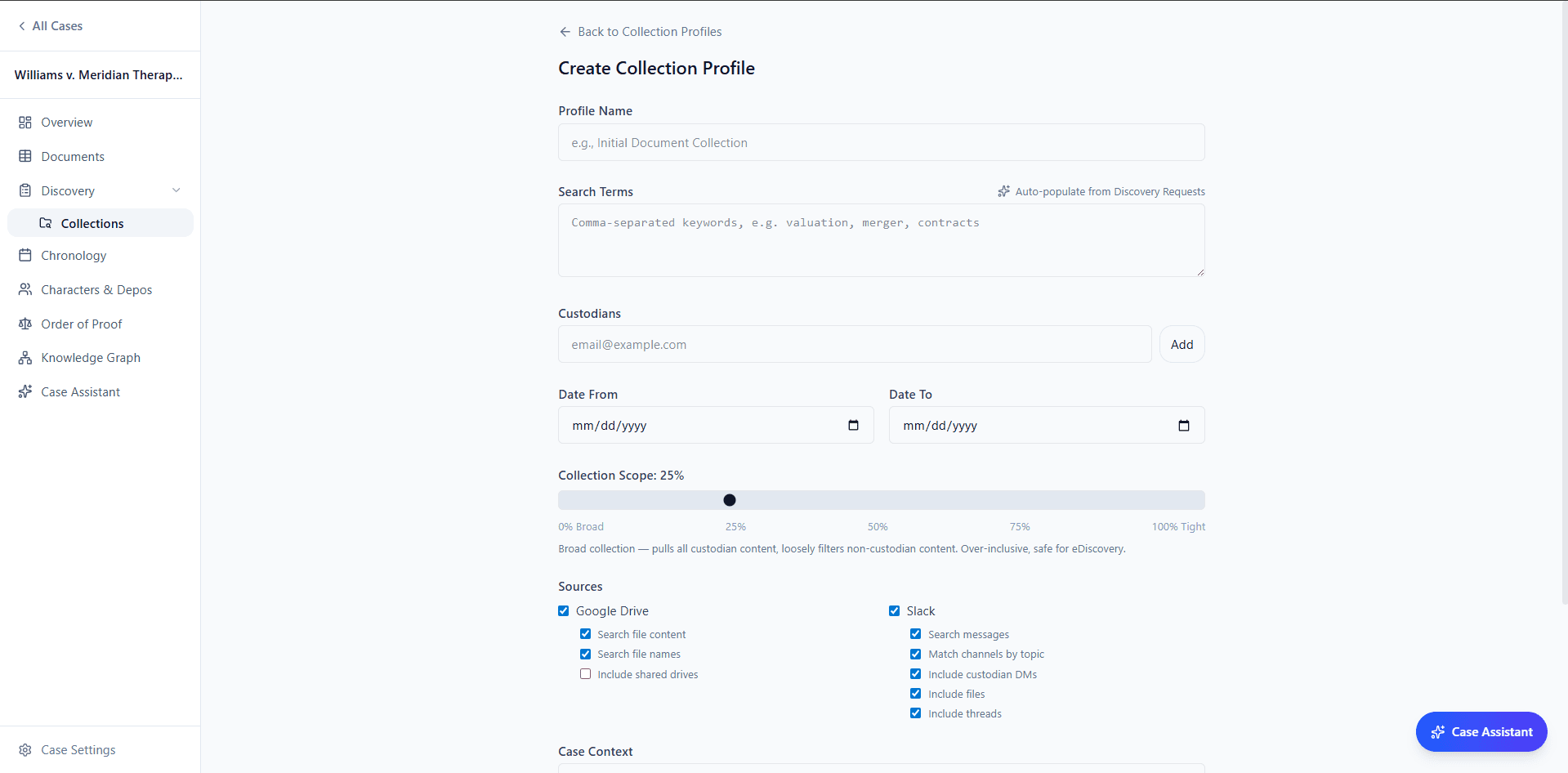
Managing large document sets is now much faster. Multi-select bulk actions let you tag, code, or move hundreds of documents at once, with real-time status tracking so you always know where things stand.
Hot Documents now live in a dedicated subtab with AI-driven relevance scoring - the most important documents in your case surface to the top automatically. On the other end, a new cold storage system uses the same relevance algorithm to identify and suggest moving irrelevant documents directly to archival storage - keeping your workspace clean and saving clients thousands on storage costs.
Knowledge Graph
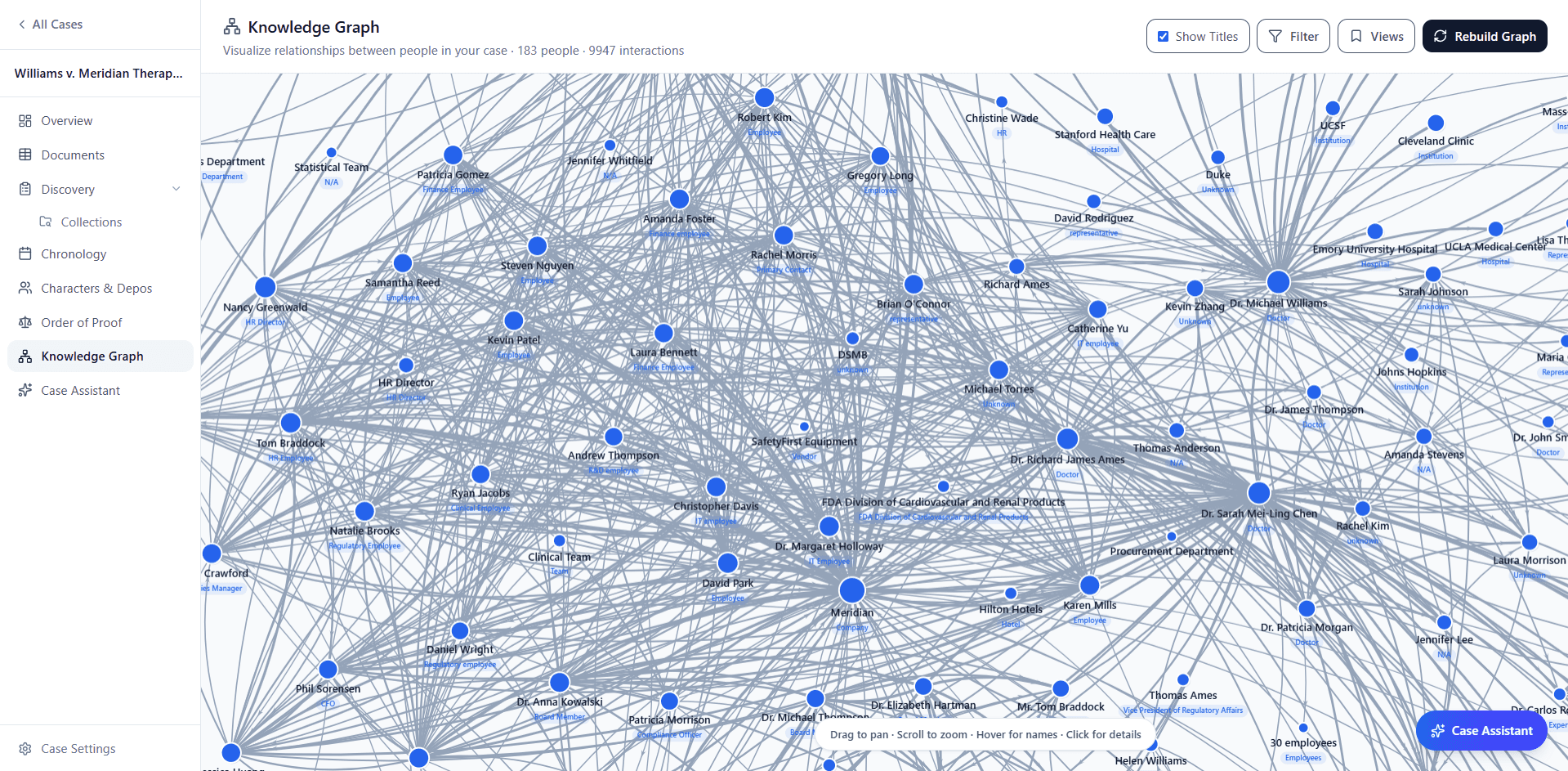
The knowledge graph now builds incrementally - as new documents are added to a case, the graph updates automatically without needing a full rebuild. This means your entity map stays current in real time as the case develops.
We also shipped a connection explorer with visual filtering, making it easier to trace specific relationship paths between entities and zoom in on the connections that matter most.
Deposition Prep
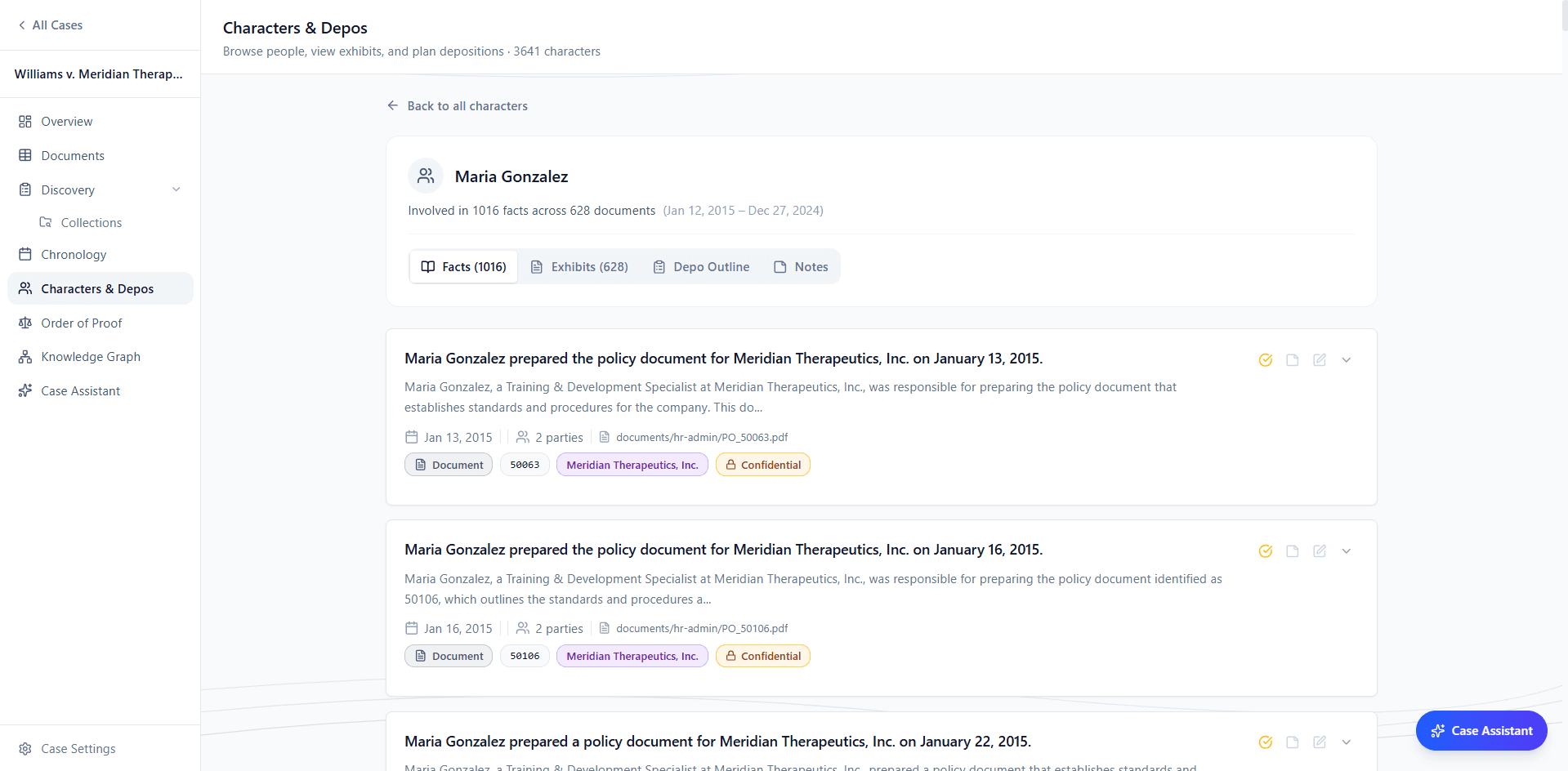
You can now generate and save full deposition outlines directly from a character's profile. The AI drafts topic areas and questions based on the exhibits and facts linked to that person, giving you a working first draft that you can refine and reorganize. Outlines persist across sessions so your team can collaborate on them over time.
Even better - the AI model can be customized to your style. Share prior examples of depositions you've taken, and the system adjusts its tone, question structure, and approach to match how you actually depose witnesses. The more examples you provide, the more tailored the output becomes.
What's Next
February was about laying the foundation - a production-grade infrastructure, a real review workflow, and the AI capabilities to make it all work at scale. In March, we're focused on deepening every module based on feedback from the teams using the platform today. We're building this alongside real litigators and in-house counsel, and that's what makes it different. If you want to be part of shaping what comes next, we'd love to hear from you.
Want to see Lumios in action?
We're running sandboxes on mock case data right now. Book a call and we'll get your team set up in 20 minutes.
Book a CallBest,
Dhruv & Arnav